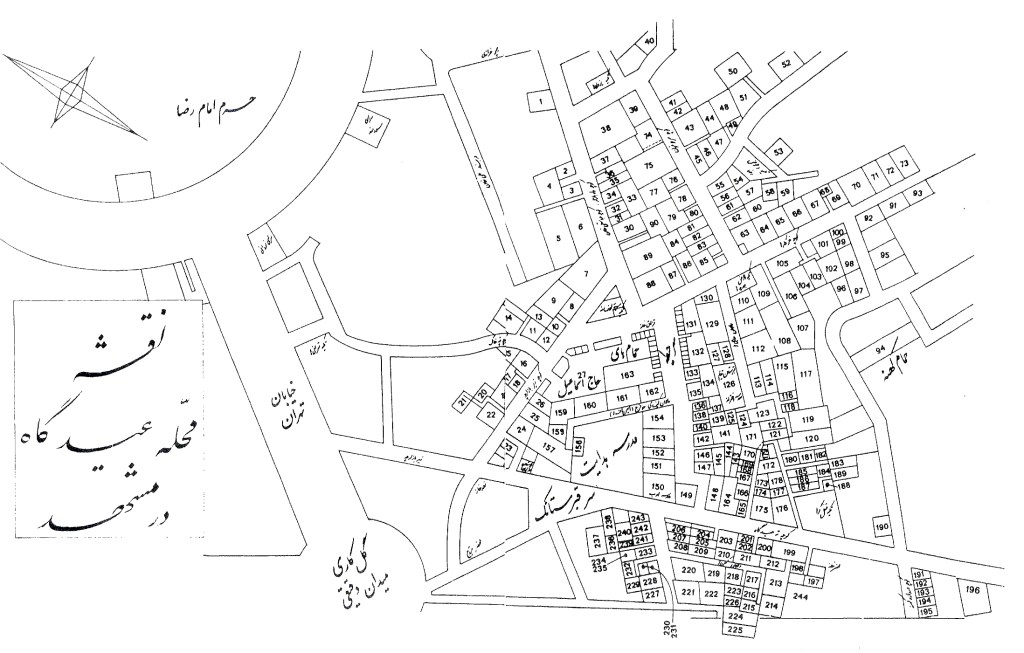
Walk through Eidgah, the Jewish quarter of Mashad, today and many, if not most, of its main streets are still there. What has changed is what stands along them. The small alleyways that once ran between the houses are largely gone, and the buildings themselves have been redeveloped so completely that few of the original structures remain. You can still walk the streets our families walked; you can rarely stand in the houses they lived in. This map shows where those original buildings stood.
What the buildings were, who lived in each, and how each was used survives in the record. The fullest single document of the quarter is a detailed plan, drawn around the turn of the twentieth century, showing 243 numbered parcels, each one a household, a courtyard, a synagogue, a school, or a shop. That plan, together with the key identifying who lived in and used each parcel, was preserved and published in Two Centuries of Resistance: The History of Mashadi Jews, Volume I, compiled by Shlomo Kaboli for the United Mashadi Jewish Community of America.1 Nearly everything on this map comes from that volume; this project would not exist without it.
What this project adds is organization and access. The parcels, names, and uses recorded in the book have been transcribed into a structured database, each lot has been traced and placed over present-day satellite imagery of Mashad, and the whole has been built into a single interactive map you can search and open on a phone. In other words, the documentation already existed; this project turns it into something you can use.
You can open the map here:
👉 map.mashadihistory.com
What you can do with it
- Search by family name. If a family’s name is attached to a parcel in the record, type it in and the map will take you to where that household stood.
- Tap any parcel to see what is recorded about it: its number, its owner or use, and its name in both Persian and English.
- “Find me.” If you are ever in Mashad near the shrine, the map can use your phone’s location to show where you are in relation to the old quarter.
- Switch between satellite and street views, to see both the present-day buildings and the road grid that replaced the quarter.
- Color-coding by type: homes, synagogues, schools, the public bath, shops, storage, and the cemetery each appear in their own color, so the shape of a whole community comes back into view.
How accurate is it?
Precision matters here, so it is worth being exact about what the map does and does not claim.
The original plan was drawn by hand and not to scale. Its proportions are distorted in ways no single mathematical transform can correct: one block is compressed, the next stretched. To place it on real imagery, each block and all 243 parcels were traced individually and fitted block by block onto the modern streets, anchored at the few points that can still be verified on the ground.
In practical terms, the map shows the right neighborhood and, block by block, very nearly the right place, but it is an approximation, not a survey. A given parcel may sit some meters from where its walls actually stood. Read it as “this is the corner where your family lived,” not “this is the exact square meter.” Where a placement is an estimate rather than a confirmed location, the map says so in the parcel’s own details.
Places that still stand
Almost all of the original buildings are gone, but not every one. A handful of structures appear to survive, and the map marks them.
Two can be pointed to with confidence, since their identity and location are confirmed and you can see them:
- Haji Ismail’s Bath House (Garmabe-ye Eslam), parcel 27: still standing, with a photograph of its interior on the map and a link to view it on the ground today.
- The Azizollahoff Caravanserai, parcel 38: also standing, its restored timber galleries and brick arches still visible, likewise with a photo and a map link.
Both of these link out to their Google Maps listings, where visitors have posted many more photographs than the map itself can hold: interiors, architectural details, and present-day views that are well worth exploring on your own.
Three more places associated with named families appear to survive in some form, but I want to be clear that their identification and placement are our best estimate, not confirmed:
- Nasrollah Hakim’s house (Karbalai Mohammad Safi), parcel 65
- Farajollah Kashi’s house, parcel 102
- The Ghafarzadeh house, parcel 103, known today as the Qafori House
For these three, the Google Maps location is a careful estimate, and the map flags it as such. If you have firsthand knowledge of any of them, or know of other structures from the quarter that survive, that is exactly the kind of correction that makes this record better.
What is still open
This is a first version, and an honest record carries its open questions:
- Some parcels are unnamed or uncertain. Not every household on the plan was recorded with a family name, and some readings are tentative.
- The block-by-block fit can still improve as more points are confirmed on the ground.
- Photographs and memories are missing. The map gives you the where; it cannot give you what the place was like.
Contribute to the record
This map is a working resource, not a finished monument. It improves every time someone supplies a correction, a name, a memory, or a photograph. If you find your family’s parcel, or find a mistake, please write in. Corrections are as valuable as discoveries, and both go back into the database for everyone.
👉 map.mashadihistory.com
Footnotes
- Shlomo Kaboli, comp., Two Centuries of Resistance: The History of Mashadi Jews, Vol. I (United Mashadi Jewish Community of America). The neighborhood plan and parcel key are reproduced in that volume (pp. 494-499); the parcel numbers, names, and recorded uses on this map are drawn from it. ↩


Leave a Reply