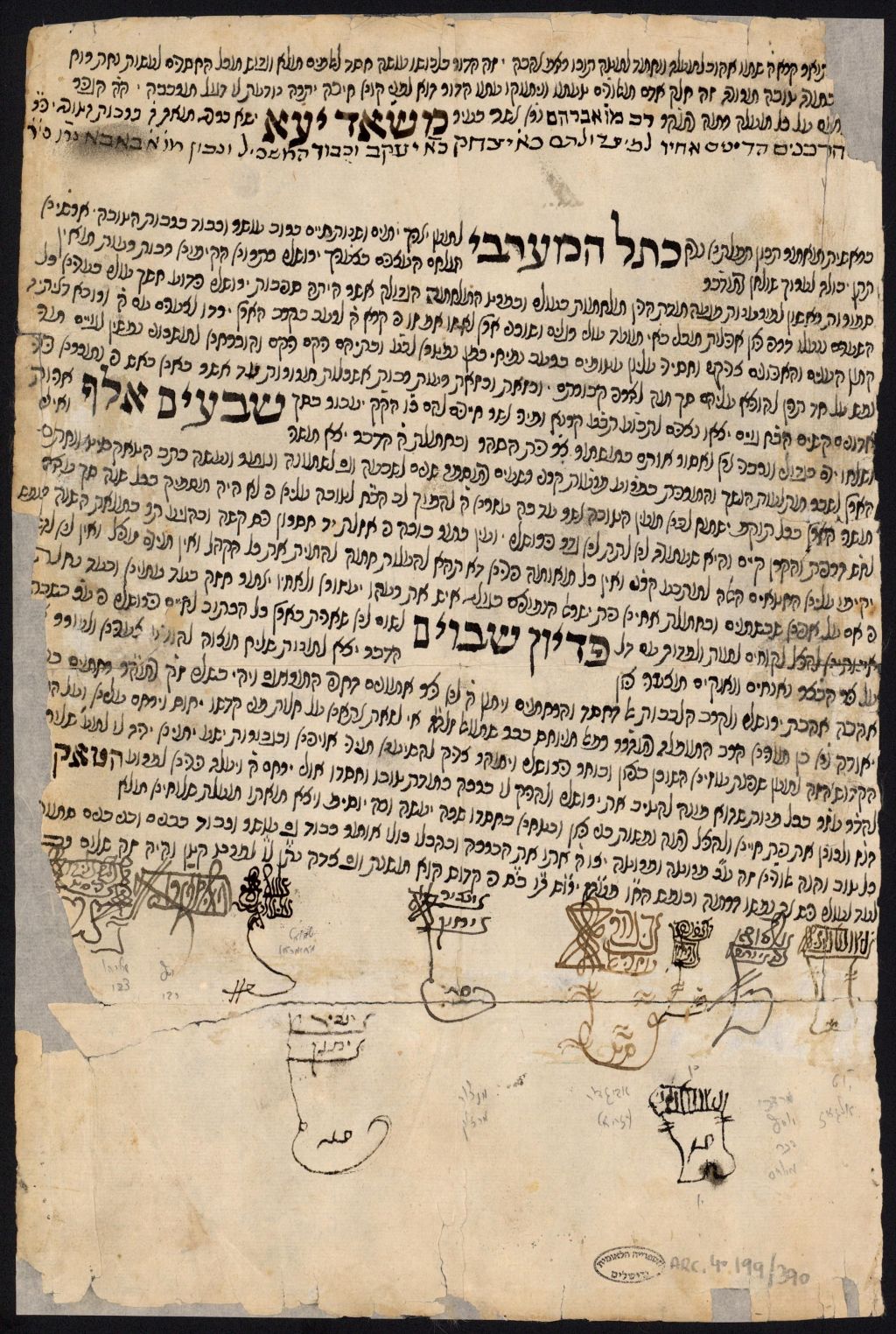
While going through some archival material recently, I came across a historic letter1 that I believe very few, if any people in our community, or even in broader Mashadi research circles, were aware of. This letter was sent from the leading Sephardic rabbis of Jerusalem, dated in April/May 1776—names that carry incredible weight, like Rabbi Yom Tov Algazi and possibly Rabbi Moshe Yosef Mordechai Meyuchas (mistakenly identified as R’ Mordechai Yosef Meyuchas). And incredibly, it was addressed to our very own Mashadi Jewish community of Iran.
That’s right. A direct connection between the spiritual center of Jerusalem and our then-young, somewhat remote community in Mashad, dating back over 200 years.
The letter was written on behalf of a shelucha derabbanan (שד”ר)—a rabbinic emissary sent from the Holy Land to raise desperately needed funds for the Sephardic Jewish community in Jerusalem. The signatories include not just Rabbi Algazi and Rabbi Meyuchas, but also other rabbinic figures like Rabbi Yaakov L’vet Chazan, the Kabbalist Rabbi Avigdor Azriel, Rabbi Mansur Marzuk, Rabbi Shemuel Maimerman, Rabbi Refael Yosef Ben Robi, and Rabbi Eliyahu Tzvi.
The language of the letter is respectful, and four Mashadi community members are mentioned by name. It reflects a connection that spanned thousands of miles across deserts and mountains. It shows us something remarkable: even in the 1700s, our community was on the radar of the great spiritual leaders of the time.
Why This Matters
This discovery opens a window into the untold relationships between the Mashadi Jewish community and the wider Jewish world.
Our ancestors had only recently arrived in Mashad after being relocated from Qazvin and Deylaman. We were a small, developing community. And yet, the great rabbis of Jerusalem knew about us. They reached out to us. They trusted us to respond to the call to support Torah, community, and survival in the Holy Land.
Analysis & Deeper Context
What is a שד”ר (Shelucha DeRabanan)?
In the 17th and 18th centuries, it was common for communities in Israel—especially Jerusalem, Tzfat, Tiberias, and Chevron—to send emissaries (שד”רים) to Jewish communities across the Middle East, North Africa, and even Europe. These emissaries were usually well-respected Torah scholars entrusted with raising funds to support the often-impoverished Jewish communities of the Land of Israel. Their letters of endorsement—like the one we found—were signed by the city’s rabbinic leadership to lend authority and credibility.
Who Were These Rabbis?
- Rabbi Yom Tov Algazi (1727–1802) was the Chief Rabbi of Jerusalem and one of the most prominent Sephardic figures of his time. He was the son of Rabbi Israel Yaakov Algazi and was known for his deep Torah knowledge and his leadership of the Jerusalem community.
- Rabbi Moshe Yosef Mordechai Meyuchas (d. 1805) came from the famous Meyuchas family, known for its scholarship and service in Jerusalem for centuries. He was the Rishon Letziyon from 1802 – 1805. He authored Shaar HaMayim, Berachot Mayim, and Mayim Shaal.
- Rabbi Yaakov L’vet Chazan, Rabbi Avigdor Azriel, and Rabbi Eliyahu Tzvi are less documented but were evidently key figures in Jerusalem’s rabbinic circles during this time.
- Rabbi Mansur Marzuk, Rabbi Shemuel Maimerman, and Rabbi Refael Yosef Ben Robi appear in some Sephardic records as communal leaders and signatories on similar rabbinic letters.
Their signatures together indicate this was not a casual note, but a serious and unified appeal—likely part of a coordinated fundraising effort.
Unanswered Questions for Further Research
- Who were the individuals addressed in the letter?
- Mollah Rav Avraham, his brother the dayan Rav Yitzchak, Yaakov, and Baba are mentioned with reverence.
These may have been early leaders or philanthropists in our Mashadi community. - Do their names appear elsewhere in our records of the community at this time?
- Mollah Rav Avraham, his brother the dayan Rav Yitzchak, Yaakov, and Baba are mentioned with reverence.
- How did these rabbis know about Mashad?
Was there a connection between our community and the Rabbis of Jerusalem that we previously did not know about? We know from other sources that Rabbi Mollah Or Shraga of Yazd once sent a letter recommending a shelucha derabbanan from Chevron to the Mashadi community (more on this in a future post). So it seems the Jerusalem rabbis had some kind of correspondence or chain of communication—perhaps through the Jewish community in Yazd, or other communities in Iran. - Why Mashad?
Mashad wasn’t a large or rich community yet. The fact that we were chosen as recipients of this letter suggests that even in our early days, we had a reputation for generosity, for Torah support, and for being connected to the broader Jewish world. - The name of the shelucha derabbanan is unclear. The letter does seem very similar to many others (like this letter designated for the city of Brody). Can it be the same emissary? An in depth translation and analysis of this letter, and comparisons with the eminent expert on shluchei derabbanan Avraham Yaari‘s book שלוחי ארץ ישראל may answer these questions, and more.
Conclusion
This letter is more than a piece of old paper. It’s a message across centuries. A reminder that we’ve always been part of a living chain of Jewish history. Our community has deep roots and historic connections. And there’s still so much more to uncover. Share your questions and comments below!
Let’s keep uncovering our story.
- כתב שליחות לשד”ר רחמים בן יאודה בן רפאל בן שמואל מיוחס, אייר ה’תקל”ו, סימול ARC. 4* 199 / 390 אוסף תעודות שד”רים, אוסף תעודות שד”רים.; ↩︎
A special thank you to Mr Lee Dilamanian for his insights and contributions.


 Mashadi History Blog
Leave a reply to Cody Hakimian Cancel reply